
The 19th Judicial District Court
East Baton Rouge Parish sits in the 19th Judicial District. The 19th JDC is the trial court for ordinary civil, criminal, and probate matters that fall outside the reach of city, municipal, or justice of the peace courts. It is the busiest court in the parish for serious cases, and its work touches state government because Baton Rouge is the capital.
The court explains its divisions, judges, and procedures, while the Clerk maintains the public record and issues copies. The two work side by side in the downtown court complex. The official court site is the place to confirm divisions and judges before a hearing.
Louisiana Court Structure
The 19th JDC fits inside a clear state hierarchy. The Louisiana Supreme Court sits at the top, the Courts of Appeal handle intermediate appeals, and the district courts are the general trial courts. East Baton Rouge Parish is in the First Circuit for appeals.
Case flow: City Court / Justice of the Peace Court › 19th Judicial District Court › Louisiana First Circuit Court of Appeal › Louisiana Supreme Court
| Court | Role | Case Types |
|---|---|---|
| Louisiana Supreme Court | Highest state court | Discretionary review and certain direct matters |
| First Circuit Court of Appeal | Intermediate appeals | Appeals from the 19th JDC |
| 19th Judicial District Court | General trial court | Felonies, major civil, successions |
| City and lower courts | Limited jurisdiction | City traffic, misdemeanors, small civil |
The Louisiana judiciary explains this layout on its court-structure page, shown below.
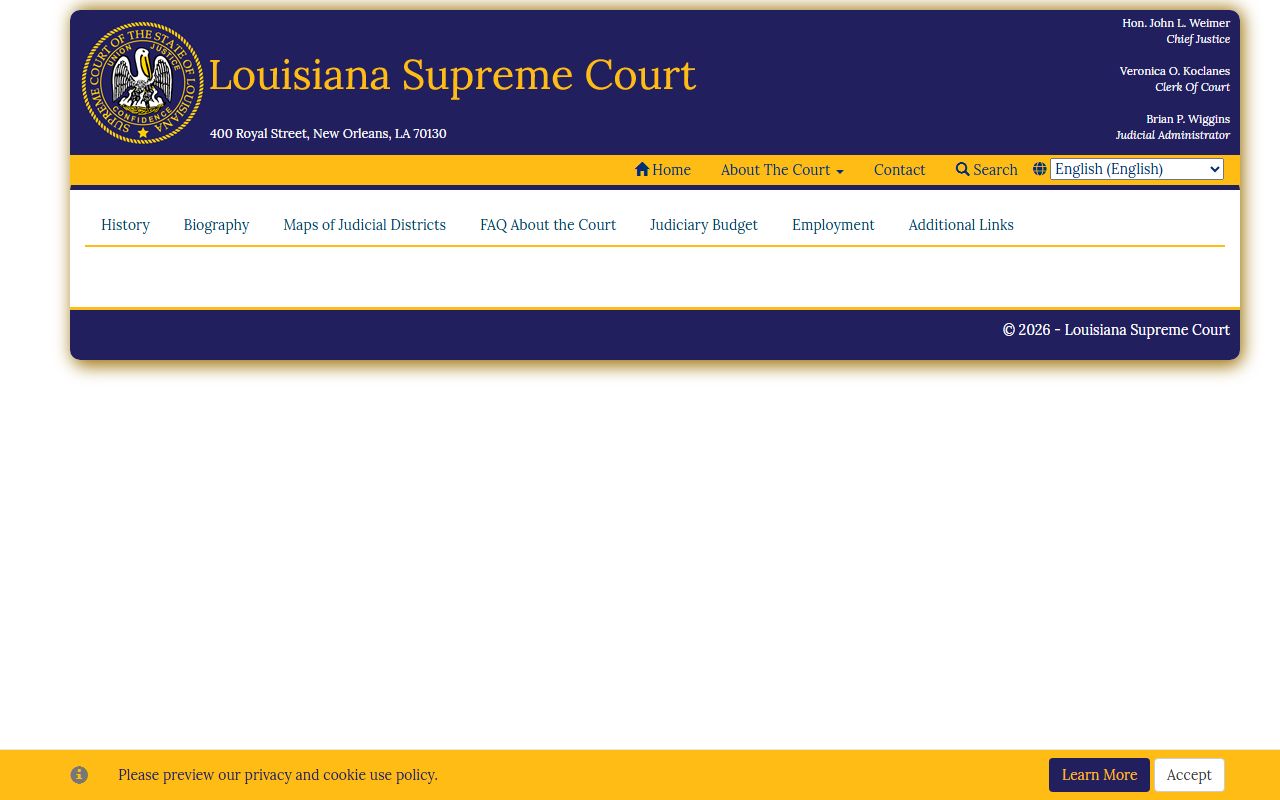
Read it through the Louisiana Supreme Court.
19th JDC Judges and Divisions
The 19th JDC has a large bench, with judges assigned to divisions for criminal, civil, and other work. The court names a chief judge and deputy chiefs for criminal and civil matters. Division assignments can change, so confirm the current division on the court's judges page before a hearing.
| Judge | Role |
|---|---|
| Donald R. Johnson | Chief Judge |
| Tarvald Smith | Deputy Chief of Criminal |
| Ronald Johnson | Deputy Chief of Civil |
| Fred T. Crifasi | District judge |
| Colette M. Greggs | District judge |
| Beau Higginbotham | District judge |
| Louise Hines | District judge |
The bench also includes Judges William Jorden, Vicky Jones, Carson Marcantel, Richard Moore, Brad Myers, Gail Horne Ray, and Eboni Johnson Rose. See the 19th JDC judges page for the current roster, and court dockets for division calendars.
Civil Jurisdiction
The 19th JDC hears major civil matters: contract disputes, injury cases, property disputes, injunctions, collections, and administrative appeals. Because Baton Rouge is the capital, the civil docket also includes cases against state agencies, public-records disputes, and constitutional questions.
Civil records include petitions, answers, motions, orders, and judgments. Most civil filings are public unless sealed by order or restricted by statute. For the documents, search court records through the Clerk.
Criminal Jurisdiction
The 19th JDC handles felony prosecutions for the parish. Criminal records include bills of information, indictments, arraignment and plea minutes, bond documents, and sentencing. The District Attorney prosecutes these cases, and the Clerk Criminal Department keeps the record.
City misdemeanors and many traffic matters go to City Court, not the 19th JDC. Booking and current custody are tracked by the Sheriff, not the court. See arrest records for how booking data and court files differ.
Probate and Succession
Probate, called succession in Louisiana, is a district-court matter here. The 19th JDC and the Clerk handle wills, petitions, and judgments of possession; there is no separate surrogate or orphans' court. Successions transfer a deceased person's property to heirs.
The probate records page covers the succession process, the documents, and how to get certified copies.
Appeals to the First Circuit
A party who loses in the 19th JDC can usually appeal to the Louisiana First Circuit Court of Appeal. The First Circuit reviews the trial record for legal error rather than retrying the case. Further review may go to the Louisiana Supreme Court, often at its discretion.
Appellate filings are not held by the parish Clerk; the appellate courts keep their own records. The First Circuit and the Supreme Court each publish dockets and opinions on their official sites.
Federal Courts in Baton Rouge
Some cases never touch the parish system. Federal criminal and civil cases for this area are filed in the U.S. District Court for the Middle District of Louisiana and searched through PACER, not the Clerk. Bankruptcy is separate from succession and is handled in the federal bankruptcy court.
Federal records sit in CM/ECF and PACER. The Middle District of Louisiana site is one starting point, as shown below.
Use PACER for federal case access and the U.S. District Court for the Middle District of Louisiana for local federal matters.
Specialty Courts and Programs
The 19th JDC and its parish partners run problem-solving courts alongside ordinary prosecution. Common Louisiana models include drug court, veterans treatment court, reentry court, and mental health court. These programs use judicial monitoring, treatment plans, drug testing, and graduation steps in place of, or alongside, a normal sentence.
Eligibility is screened by the court, the District Attorney, and the defense, and criminal history can exclude an applicant. Veterans treatment court adds mentoring and VA coordination for eligible veterans. Confirm current programs and rules with the court before relying on details, since rosters and eligibility change.
Common District Court Questions
A few questions come up often about the 19th JDC.
How do I change a court date? Only the court can change a date. Contact your attorney or the division. Filing a request does not move a date until the court grants it and confirms the new setting.
Where are the case documents? The 19th JDC hears the case, but the Clerk keeps the file. Search court records and order copies from the Clerk.
Courthouse Location and Contact
The 19th JDC sits in the downtown court complex on North Boulevard, sharing the building with the Clerk of Court. Arrive early for security screening, and bring photo identification and your case number. The contact card has the details.
19th Judicial District Court
300 North Boulevard
Baton Rouge, LA 70802
225-389-4700
Mon-Fri 8:30 a.m.-4:30 p.m.
For records and copies, see the Clerk of Court, and for family matters, see Family Court.
A Court at the State Capital
The 19th JDC carries a workload most parish courts do not. Because Baton Rouge is the state capital and the parish seat, the court hears cases involving state agencies, the Legislature, public-records disputes, and major criminal prosecutions. That capital-city role sits alongside ordinary parish litigation.
It also means a visitor downtown may encounter several court systems at once: the district court, City Court, Family Court, and the federal Middle District. Knowing which court holds a matter keeps a records search on the right track from the start.